Tuesday, January 21, 2025

Sharing Our "God Moments"


While our new Maryland bishop, Carrie (Schofield-Broadbent), was on pilgrimage to the Holy Land recently, she posted about the trip on social media. One day, she posted about sharing our God sightings. I think she was referring to those seemingly inexplicable, life-changing, sacred experiences that, all too often, we have but keep to ourselves. Some might refer to these as God moments or mystical encounters. According to one Pew Report, around half of the American population claims to have had at least one such experience.[1]


In his landmark book on religious experience, psychologist and philosopher William James proposed that there were four necessary criteria for such an experience. They must be ineffable (unexplainable), noetic (not just a feeling but more of a deep knowing), transient (passing but capable of having a lasting impact), and passive (or initiated from outside the experiencer).[2]


In such a time such as ours, I think Bishop Carrie is onto something. Theologian Karl Rahner would likely concur. In 1961, Rahner made the bold statement that the Christian of the future will be a mystic, or “he” will not exist at all.[3] (It was 1961!)


Epiphany season is party time for mystics! Remember? We’re supposed to be paying attention, watching for God sightings and signs! The Gospel of John doesn’t disappoint. Of the four, John’s is the most mystical gospel. It’s said to be shallow enough for a child to wade in and deep enough for an elephant to swim. Ready to dive in?


 An entire community is invited to a wedding party. There is food and wine in abundance, music and dancing. A week-long joyful celebration. A new family in the making. The entire early church seems to be in attendance. Jesus’ mom is there. Jesus is there, too, with all his disciples.

This party roars on and on…until:


"They have no wine." An imperative from mother to son. 


"Woman, what concern is that to you and to me? My hour has not yet come." 


Is Jesus nervous, a little apprehensive about the start of his ministry? I can relate.


Jesus’ mother presses on. 


"Do whatever he tells you,” she directs the servers.


Spotting six empty jars used for Jewish purification rites, Jesus instructs them to fill the large stone vessels with water (no easy task in the ancient world!). Then there is so much wine. Hundreds of gallons. Good wine. Like 99 on the Wine Spectator rating scale good. 


“Draw some out and take it to the steward,” Jesus tells the servers.

Amazed and astounded, the steward gives all credit to the bridegroom. “The good wine is always served first. But you, you saved the best for last.” 


The servers know. Can’t you just picture them? 


Best. Wedding. Ever.


In the Fall of 1969, Peter Yarrow, who passed away just a couple of weeks ago, asked Paul Stookey to write and perform a song for his upcoming wedding to Mary Beth McCarthy. 


As you might recall, they were members of the popular sixties folk trio Peter, Paul, and Mary. A dark cloud had descended over the country following the assassination of John F. Kennedy, his brother Robert, and Martin Luther King, Jr. Stookey felt as though his life was spinning out of control. Encouraged by a friend to read the bible, he also began to pray. He prayed before making small decisions like which elevator to take. He prayed for himself and others. Eventually, Stookey’s life began to feel more manageable.


In an interview, he describes how The Wedding Song came to be:


Retreating to his tiny basement studio, Stookey tuned up his twelve-string. After sitting in silence for a moment, he prayed, asking for God’s blessing and presence at the wedding of his dear friends:

The lyrics came quickly:

He is now to be among you at the calling of your hearts. Rest assured this troubadour is acting on his part. The union of your spirits here has caused him to remain. For whenever two or more of you are gathered in his name, there is love.

So strikingly instantaneous was Paul Stookey’s inspiration that he felt it wasn’t his song. He decided to give away the rights to a non-profit. The Public Domain Foundation was created in 1971 with royalties from “The Wedding Song.” Since then, millions of dollars have been raised for social justice causes all across the country.[4]

 @kellylatimoreicons

In his book, Stride Toward Freedom, Martin Luther King, Jr. also shares a powerful God moment:

It was a cold January night in 1956, and as he was drifting off to sleep, Dr. King received a disturbing phone call. The person on the other end of the line spouted horrendous racial slurs and violent threats. Shaken, King went to his kitchen, sat down, and prayed, pouring all of his fears and his hopes out to God.

At that moment, Dr. King shares, “I experienced the presence of the Divine as I had never experienced God before… I could hear the quiet assurance of an inner voice saying: ‘Stand up for justice, stand up for truth, and God will be at your side forever.’ Almost at once, King wrote, his fears  subsided. “My uncertainty disappeared. I was ready to face anything.”[5]


From her pilgrimage, Bishop Carrie shared this on Instagram: “We all have unique perspectives ...The God-moments that may be obvious to us may be inaccessible to others.” I totally agree! We should talk about them!

Jesus gives the mystified servers something to talk about as they share the excellent wine with thirsty wedding guests. But wait, where is the bride in this story? 


Did you catch the last lines of Isaiah? 


For as a young man marries a young woman,
so shall your builder marry you,

and as the bridegroom rejoices over the bride,
so shall your God rejoice over you.


In our marriage rite in the Book of Common Prayer, Jesus’ presence and first miracle at Cana signifies “the mystery of the union between Christ and his Church.”[6]


In the true Church, the beloved community where love, justice, and mercy flow abundantly, I think we are the bride. Therefore, those whom God has joined together let no one put asunder.[7]


In the spirit of a God moment, I invite you to close your eyes and drink this in, from Christian mystic Meister Eckhart: 


In the deep quiet of the soul where thoughts dissolve, and worries cease.

There lies a rest, a sacred whole. A hidden peace that brings release.

Let go of striving. Let go of quest. In this vast stillness find your ground.

For here within the inmost breast the divine presence can be found.

Not in the clamor of the day. Nor in the rush of worldly things.

But in the space where thoughts give way.

The soul’s true resting place now sings.

Like a still lake reflecting skies.

Reflect the light of God within.

In this deep rest your spirit flies.

A union with the divine begins.


Amen.


[1] Russell Heimlich, “Mystical Experiences,” Pew Research Center (blog), December 29, 2009, https://www.pewresearch.org/short-reads/2009/12/29/mystical-experiences/.

[2] William James, The Varieties of Religious Experience: A Study in Human Nature. (New York: Longmans, Green and Co, 1902),380-81.

[3] Karl Rahner, Theological Investigations, trans. Cornelius Ernst (Baltimore: Helicon Press, 1961) XX, 149.

[4] Noel Paul Stookey, “The Song I Had to Give Away,” Guideposts (blog), June 1, 1993, https://guideposts.org/positive-living/health-and-wellness/better-living/the-song-i-had-to-give-away/.

[5] Martin Luther King, Stride Toward Freedom: The Montgomery Story, King Legacy Ser, v. 1 (Boston: Beacon Press, 2010), 135-36.

[6] Episcopal Church., The Book of Common Prayer and Administration of the Sacraments and Other Rites and Ceremonies of the Church: Together with the Psalter or Psalms of David, According to the Use of the Episcopal Church. (New York: Church Publishing, 1979), 423.

[7] BCP, 428.

Saturday, January 11, 2025

Listening for God


Tomorrow, we travel to New York City to see our daughter Caroline in her one performance of Sunset Boulevard before she moves on to her next gig. It is exciting, for sure. But, when I spoke to her yesterday, we discussed the irony that Sunset Boulevard was literally burning while she was sitting in the basement of the theatre doing her job as a standby for the lead in the musical Sunset Boulevard. It was in the basement of the St. James Theatre that she decided to do what she could to help those affected by the California wildfires. Caroline had some free time, so she contacted her cast members, and they took up a small collection. It was something. 

What a week! Bitter cold and snow in our Maryland neighborhood while winds whipped up on the left coast, and there was fire, so much fire. The images were horrific. On top of that, there was a 7.1 in Tibet with tragic loss of life and hundreds of injuries.


Where is God in all of this? As a new “curate” (a label given to newly ordained clergy that means “cure of souls”), I think a lot about this kind of thing. Truth is, I thought about this long before I ever considered discerning a call to the priesthood. 


Where is God when the proverbial @#$ hits the fan? 


This is from the Hebrew Bible:


“The LORD said, “Go out and stand on the mountain in the presence of the LORD, for the LORD is about to pass by.” Then a great and powerful wind tore the mountains apart and shattered the rocks before the LORD, but the LORD was not in the wind. After the wind there was an earthquake, but the LORD was not in the earthquake. After the earthquake came a fire, but the LORD was not in the fire. And after the fire came a gentle whisper.”


~~1 Kings 19:11-12


Now, of course, these verses are in the context of a story of ancient-world turmoil and violence, of governments seeking power and control at the expense of the people they were supposed to be serving—nothing like today.  We’re much more sophisticated today. 


What I love about this passage is it reveals a genuine search for wisdom during a time of fear, confusion, and trauma. We could use some serious wisdom right about now.


I love that Caroline listened for wisdom and responded. I think it might be wise in times like these, in general, to get to a place where we might discern God’s gentle whisper. It might be wise to focus on what is in our control in the present moment. It is in the present moment that a gentle whisper is more likely to be heard. How can we help those in most desperate need? It might be wise to pause, to be still; to breathe deeply of the resources available in the now moment – which is really all we have. It is in stillness (some might call it prayer) that practical resources are most readily available. From there, we can take action. 


Listen for the gentle whisper. It's always there, under all the rest of the noise.


If you like, check out this yoga practice for tapping into wisdom.

Apocalypse Now (A Sermon for Advent 1)


From the 1938 broadcast

Travel with me back to the year 1938. Pockets are empty, and anxiety is at an all-time high. Newspapers feel the pinch as the rising popularity of radio competes for advertising dollars. A young man by the name of Orson Wells has an idea. He decides to assemble a 27-piece orchestra and ten fellow actors for a dramatic broadcast of H.G. Welles’ 1898 science fiction novel The War of the Worlds. The production features news alerts of an imminent Martian invasion of New Jersey. The broadcast is stunning, riveting, spellbinding, heart-stopping…


Some listeners, perhaps tuning in late, mistake the fictional play for the real deal. Frantic phone calls to police, newspapers, and radio stations convince journalists that the show has incited nationwide hysteria. Newspapers, anxious to cash in on the event, jump at the chance to sensationalize. By the next morning, 23-year-old Wells is famous, his name and face plastered on front pages from coast to coast. Headlines herald the mass panic his broadcast has allegedly inspired. This effort to discredit the radio program only enhances its impact, shoring up a burgeoning addiction to mass media.


With constant access to social media and a relentless 24/7 news cycle, we’re still pretty addicted. 


Only now we have more sophisticated media. Our phones, video games, and virtual reality all compete for our attention, but eventually, these will pass into obscurity. 


We need look no further than our Gospel passage to appreciate how the bible, this most influential, interesting, most misunderstood best-seller of all time, can still stir our hearts and capture our imagination. 


“Signs in the sun, the moon, and the stars, and on the earth distress among nations confused by the roaring of the sea and the waves. People fainting from fear and foreboding of what is coming upon the world, the powers of the heavens shaken. Then they will see 'the Son of Man coming in a cloud' with power and great glory.” 


Luke’s Jesus knows how to generate buzz. 


Luke’s Gospel was likely written at least partially in Rome, sometime between years 62 and 70. Luke, also believed to have authored the book of Acts, was not one of the original disciples but was a traveling companion to the Apostle Paul, author of our Epistle. In another of his letters, Paul tells us Luke was a physician. We’re pretty sure Luke used the Gospel of Mark for reference. Luke’s audience is a growing gentile or non-Jewish audience awaiting Christ’s return amidst a dangerously hostile political climate. 


Cut to Advent 2024. We enter a new liturgical year for the church. Advent is a time of preparation, waiting, and expectation… 


As we light candles of hope, peace, joy, and love on each of the four consecutive Sundays of Advent, we prepare for the coming of God’s kingdom into our world, into the joy and the mayhem of our individual lives. And like the early Christians, we wait expectantly for Christ’s return. 


“O come O come Emmanuel and ransom captive Israel that mourns in lowly exile here, until the son of God appear.”


Tom Petty was right, “The waiting is the hardest part.” 


Jurgen Moltmann, who passed away at age 98 this year, is considered one of the most important theologians of the 21st century for his revolutionary and somewhat controversial teachings.


He writes, “…Faith, wherever it develops into hope, causes not rest but unrest, not patience but impatience. It does not calm the unquiet heart but is itself this unquiet heart in (us.) Those who hope in Christ can no longer put up with reality as it is but begin to suffer under it, to contradict it. Peace with God means conflict with the world, for the goad of the promised future stabs inexorably into the flesh of every unfulfilled present.” 


Reading Moltmann is a little like reading science fiction, only better - because it’s rooted in the grittiness of real life.  By the ‘promised future,’ I believe Moltman refers to something like Kairos time (as opposed to Chronos or linear time) – Kairos is Greek for the right, critical moment. Kairos is God’s time. Fluid and unpredictable, with a magnetic pull toward justice and redemption. In God’s time, God breaks through, and anything can happen. 


“Stand up, raise your heads, because your redemption is drawing near.” Luke’s Jesus interrupts the regularly scheduled programming of the anxious first-century Christ follower with a reminder to “keep alert.” 


How long, God? How long, I imagine the apostles ask, as, one by one, many of them die horrible, violent deaths. Paul was martyred around the year 70. It’s thought that Luke finished his gospel in the aftermath of that traumatic reality.


During time spent as a prisoner of war, Jurgen Moltmann encountered Christ in the holy scriptures and the kindness of strangers. In a blossoming cherry tree out his window, he found hope for new life after the devastation of war. For Moltmann, everyday experiences reveal the inbreaking of God into our lives, and most especially into our suffering. Moltmann’s theology is not pie in the sky. It distinguishes hope from mere optimism. Hope, it seems, is less about dreaming and more about paying really close attention.


All year, but perhaps especially during Advent, we’re called to assume a posture of receptivity: to stay alert for the inbreaking of Christ. In doing so, we are agents of our own transformation, co-creators with the Holy Spirit of the Kingdom of Heaven, here and now. 


Where have you noticed God breaking through in your life this past week? Turn to a neighbor and tell them about it. 


Was that hard? It gets easier with practice. My friend, who recently found her cancer has reoccurred, is good at this. These days, she seems to encounter God just about everywhere, even on Facebook, as she keeps us updated. Like so many others, she regularly stops in front of the huge statue of Christ in the dome of Johns Hopkins Hospital, where she goes for treatments. But the inbreaking Christ may not always be so obvious. Think babies, blossoms...bumper stickers…


My friend and her doctors have been vigilant, so they’re hopeful. Still, she waits for results as her friends and family enfold her in prayer. 


My friends, during this extraordinary and challenging season, may we lift our heads and hearts in expectation of Emmanuel – God with us. May we stay receptive and alert to hope that just might be reaching out to us from a long-promised future. 


In Spirit Wheel, Meditations From an Indigenous Elder, former Episcopal  Bishop Steven Charleston writes: 


Don't look down, don't look back, don't look away. 


Don't look down with your head bent by sorrow or fear, for the courage you have within you is reason enough to hold your head high. 


Yes, you carry a heavy burden, but you know you never carry it alone. Look up, for love still has much to show you. 


Don't look back to the old hurts and struggles, for they have had their moment and cannot live in the light of this new day. 


Look ahead to what life offers you now. Don't look away from the challenges before you, no matter how hard they may seem. 


Breathe in the strength of the Spirit and trust what guides you. Look your truth straight in the eye and capture the vision that will set you free.


Heads up, friends. Christ is coming. Always and in All ways. Happy New Year. Welcome to Advent.

Sunday, February 18, 2024

Why are There so Many Songs About Rainbows?


Link to Lectionary Page for Lent 1, Year B


Let us pray: Gracious and loving God, creator of all things colorful and mysterious, seen and unseen, grant us courage to faithfully encounter the storms and vicissitudes of life, wisdom to guide us, hope to sustain us, and joy in the promise of your abiding presence. Amen.


Living here near the water, I suspect some of you have or maybe have had a boat. Weird random question: Have you ever had the occasion to hire a boat detailing company? If so, do you happen to recall the name of the company?

A couple of weeks ago, I was driving North on Ocean Highway to All Saints. I had just started working on this sermon. Pondering the significance of Noah’s Ark story, I had been listening to some songs about rainbows on Spotify. There are quite a few of them. It’s truly a gift to drive such a scenic route to work. I don’t take it for granted. At the entrance to the Indian River Inlet Bridge with that gorgeous vista of shimmering sunlight on water, I was feeling grateful and inspired to dive deeper into the story of Noah. As I ascended the bridge, a white van shows up in the lane next to me. In bright cobalt blue lettering, there were two words: Ark Details. You can’t make this stuff up!

The story of Noah is a familiar one - certainly, a Sunday School favorite. God warns Noah about the impending flood and instructs him in great detail to build a big boat, an ark. God gets very specific in Genesis 6:

“Make yourself an ark of cypress wood; make rooms in the ark and cover it inside and out with pitch. This is how you are to make it: the length of the ark three hundred cubits, its width fifty cubits, and its height thirty cubits. Make a roof for the ark, and finish it to a cubit above, and put the door of the ark in its side; make it with lower, second, and third decks.” (Genesis 6:14-16, NRSV)

God is in the details, it seems, even architectural ones. 

C’mon, all those animals! And that spectacular rainbow; a sign of God’s new covenant with God’s people.

I get why there are so many songs about rainbows.

They’re pretty incredible. 


One day during the pandemic, I noticed some of my neighbors standing in the middle of the street looking up at the sky. When I went outside to see what was up, there was a gorgeous rainbow encircling our home. Our house was perfectly centered inside it. Our neighbors hadn’t seen one another much since the pandemic started. From a safe distance, we caught up as we stood awestruck, gazing upwards. 


The colors of the rainbow so pretty in the sky, also in the faces of people passing by. Thanks Louis Armstrong.


Here’s a little-known intro to perhaps our most familiar song about a rainbow. See if you recognize it:

When all the world is a hopeless jumble
And the raindrops tumble all around
Heaven opens a magic lane

When all the clouds darken up the skyway
There's a rainbow highway to be found
Leading from your windowpane to a place behind the sun
Just a step beyond the rain

(You know it! Somewhere over the rainbow…)

Songs, stories, images of rainbows can inspire hope when all we see is darkness. Like in a global pandemic. 

Of course, some suffered more than others. Kids are still catching up in school. A lot of us are still grieving. 


It was scary. Life changing. Death dealing. I might even go so far as to say it was like a flood. If you have lived through a flood, you know what I am talking about. 


The ancient Israelites knew this kind of devastation. Their “flood” was losing everything that was beloved and familiar; their land, their community, their culture, their religion…


When we read the Hebrew Bible through the lens of exile, loss, and grief, through the lens of racism or refugee crisis, we can get a whole different picture. Scholars believe Genesis isn’t the only book of the Bible written during or soon after the Babylonian exile. (Think Daniel, Ezekiel, Esther, Ezra, portions of Isaiah...) 

The ancient Israelites were a faithful people, living close to the Earth, whose land had been taken away. To process their losses and preserve the stories of their culture for future generations, even the difficult and violent parts, words, stories, histories, and poetry were shared and passed down. Jesus knew these words and the devastating trauma his Jewish ancestors had experienced. 

In this week’s Gospel, the writer of Mark seems to use only the necessary words. Mark leaves out specific details, which we get in Matthew and Luke. Instead, we hear Jesus is driven by the Spirit to the wilderness. There are wild beasts and angels. We learn that John the Baptizer has been arrested and that Jesus goes right to Galilee to proclaim that the kingdom is near. Believe the good news! 

Mark was writing for an early church under oppression. Mark’s sense of urgency may be showing up in his words, or lack thereof. Perhaps his intention was to encourage new Christians to quickly spread the good news. The kingdom is near. Repent (in Greek, meaning a capacity for change). For Mark’s readers, news of John’s arrest may have been a warning to be cautious. Perhaps we are to pay attention to what the Gospel writer is not saying about Jesus’ time in the wilderness. When under stress, our human tendency can be to focus on the negative. Have you noticed? Social scientists label this negativity bias. 

Negativity bias can affect the way we think, act, and move through the world and, over time, can have less-than-desirable effects on our mental and physical health. After a while, it becomes a habit.

Did your focus land on the flood or the rainbow? Satan or the angels? Fear or good news? Did the wild beasts seem threatening or adorable? 

For a seminary class, we are reading Burnout by Emily and Amelia Nagoski. In it, the authors share research about the importance of completing the stress cycle. We know chronic stress causes dis-ease. Paying attention to the physiological stress responses of our bodies is critical to our wellness. When chronic stress sends us into fight, flight, or freeze, the authors say, we must complete the cycle. The way to complete the cycle is instinctual. What do we do when we are being chased by a lion? We run! The authors say moving our bodies is the single most efficient way to complete the cycle – just 20 minutes a day can be enough.

But there are other ways. There’s breathwork. A six-second kiss or a twenty-second hug. I would add prayer. And I wonder if the physical act of writing down our stories could be another healthy way of completing the stress cycle. The ancient Israelites seemed to feel it was important. 

We might meditate quietly on our psalm for today:

“Show me your ways, O LORD, and teach me your paths.” 

Friends, God is in the details of our lives and our Lent. We are God’s beloved. Remember to look up.

I’ll leave you with this blessing from Psalm 25 vs. 3, Eugene Peterson’s The Message translation:

From now on every road, you travel
Will take you to God.
Follow the Covenant signs;
Read the charted directions. 


Friday, February 17, 2023

Thoughts and Prayers: Steps Toward Positive Change...for Seniors


In this article in the New York Times, we find that Covid is still disproportionately affecting our senior population, resulting in more frequent hospitalization for those over 65 and, sadly, in all too many cases, death. For some, the stress of hospitalization adds an added layer of stress which can set off a litany of a whole new set of symptoms that can sometimes require repeated hospital stays. Covid can trigger a downward spiral for seniors. 


Researchers at the National Institutes of Health have found that, while sometimes lifesaving, hospital stays can also be dangerous for the senior population. The lack of sleep, poor nutrition, and disruption of daily schedules can elicit unhealthy stress responses that can exacerbate existing physical, mental, and cognitive decline.


The pandemic has revealed the myriad insufficiencies in our current healthcare system, which functions in tandem with family caregivers who, more and more, struggle to help their loved ones due to pervasive systemic challenges. In many cases, families are left to make life-and-death decisions for their loved ones. In many cases, caregivers are burned out, depressed, and/or dealing with health challenges of their own. Disturbingly, recent studies have reported numerous health concerns for long-term caregivers for whom options for support are limited.


What can we do to better serve our senior population? How can we support caregivers who unselfishly provide crucial support to loved ones in the final years of their life? Where can religious organizations step in? Where does healthcare need to step up? What are some promising steps that are already being taken? 


I welcome your thoughts. And your prayers. 


Monday, January 23, 2023

Mindful Monday: Speaking (and Singing) our Truth

 I might have a slight throat chakra blockage.  

I have come to appreciate that there is wisdom in the Tantric Chakra systemwhich I learned about in my yoga practice and teacher training. The word chakra means wheel or disk. The chakras are spinning wheels of energy that facilitate the smooth, balanced movement of energy in our physical, emotional, and spiritual bodies. As long as we are living and breathing, our wheels are turning in an effort to keep us healthy and to help us evolve spiritually in the physical world. When we die, we close the final gates, the yogis say, and we spread our wings and fly to the next life. We let go. We are free from the physical restraints of the body. 


I was raised in the Christian tradition and am on the ordination track to become a priest, so some might say I am heretical to even consider the benefits of the study of another faith tradition. I beg to differ. Respectfully. We can learn a lot from other traditions and would be wise to open our hearts and minds to the wisdom that is available to us from other contexts. That is the key to peace, in my humble opinion.

Back to my throat chakra imbalance. I didn’t forget (which, incidentally, can be a symptom of a blocked throat chakra!) While I have been grieving the loss of my earthly father, who died recently after a short period of in-home hospice care, I have also been studying in seminary. God willing, I will be ordained a priest in the Episcopal Church in the next couple of years. Crazy, right? I know. But it is a thing. I have been on this path for several years now, discerning in community about my potential call. It is not one to be taken lightly, and there are gates (kind of like the gates of the chakras, actually) that we pass through at several different junctions to ensure that this path is right for me and for the Christian community I will eventually serve. It is sometimes intense. And it is a mysterious and mystical journey I would not want to miss. As an added bonus, I have made some wonderful new friendships along the way.


Meanwhile, back at the brilliance of the chakra system, one might say the heart and the head have been working overtime. With all the studying and paper writing, alongside the loss of my beloved dad, there has been a lot of activity in the heart chakra and up in the head as well. Right there in the middle lies the throat chakra, the center of our communication, our energetic connection between our mind and our body. The yogis have a symbol for it, and it is associated with the color blue. But I see the throat center as an outward expression of our soul, to get very real about it. The throat is a portal through which our deepest truth is revealed. That is why singing can be experienced as such a vulnerable thing. 


I have always felt singing to be a joy. I sang in the church choir as a kid. I sang in musical theatre productions for many years, and I was a professional a cappella Christmas caroler for more than fifteen years of my adult life. Singing is a joy for me. But when I was asked to officiate a sung evening service at my seminary recently, I practically freaked out. Fortunately, I had been Zooming into classes after the death of my father, and I was not available, but I still freaked out. “I don’t know how to do that! How could they expect me to sing something I have not even rehearsed? I am a professional. I need rehearsal!” Suffice it to say, there was resistance in my throat chakra to this simple request that wasn’t even going to happen anyway. But my somewhat unbalanced emotional response was telling. I am grateful for the truth that this potential train wreck of an opportunity (as I saw it) had to offer. 


In many ways, our capacity to move through the grieving process is involved with our ability to wrap our minds around our losses and allow them to be processed in and through the physical body. If there is fear or an extreme amount of stress or trauma, our natural ability to move energy through our system can be challenged. 


All the chakras are important, but when we are grieving, it makes a lot of sense to care for our throat center. We can do this by drinking lots of clean water and soothing teas and wrapping our necks with a warm scarf when it is cold out. We can make sure to gently move that area daily and swallow in our throat to keep that area supple and relaxed. We can consciously breathe into the throat center to activate that area. We can practice a yoga practice like this one from my YouTube channel. And we can meditate on this area to clear our throat chakras when we sense that they are needing extra attention. For me, yoga has been nothing short of a gift. Paying mindful attention has become a vital part of my self-care and a lovely companion to my Christian formation. 


My throat chakra affirmation: I speak and sing my truth with compassion and love. 


What is your throat chakra affirmation?


Saturday, September 3, 2022

Praying for Pigeon

 Love one another.
      ~~Jesus

In all the busyness this week, I almost missed it. A subtle but profoundly clear message from the universe. At the end of a long exhausting week, it was Emma, the pretty, perky yoga instructor in her crop top, yoga shorts, and baseball cap, who literally and figuratively straightened me out. As we settled in on our mats, she introduced her new fiancé to the class. The burly, bearded, precious young man/yogi unapologetically took up prime real estate in the front row of class. He was there for Emma; this was evident. And Emma showed her gratitude by dedicating the class to her beloved.

Like many yoga teachers, Emma started class with a dharma talk, a short sermon-like speech about something the teacher deems important. Emma reminded the class on this day that we should make it a point to appreciate our “people,” those folks who love us, show up for us, and care for us. To further drive home her message, Emma’s playlist included one love song after another, ending the practice with Ellie Goulding’s How Long Will I Love You? It was a little distracting but also very sweet. 


I had come to the class to be taught by someone else; to practice, I reminded myself. I didn't want to think. Yet predictably, my thoughts frequently drifted from the present moment, thinking about Emma’s choice of music, the rising temperature of the crowded room, or a random foot that landed unexpectedly in my face. At some point in the class, I found myself praying for pigeon pose.  


Eka Pada Rajakapotasana, or Pigeon pose, is no joke. With one leg extended back and the other at a near right angle in front, it is a hip opener of epic proportions. Pigeon challenges us to breathe deeply and stay in the moment. It is an invitation to stay and be with discomfort. It is said that pigeon can release pent-up emotions that we unconsciously store in our hips. Sometimes in a hip opener, emotions arise, and our job, our practice, is to observe them without judgment. This, according to yogic wisdom, is how challenging emotions are dislodged from the body. I always feel better after pigeon, and so I prayed.


Prayers have been flowing a lot this summer. I have prayed for my “people” and my people’s people. I have prayed for the world and for my own little world, which has enlarged to include a cohort of seminary friends and professors. And as a new semester is before me, I pray for the grace to navigate new lessons, new ideas, and unfamiliar territory. Because sometimes, I tend to grit my teeth and push through incredibly tough things without leaning on others, I pray for the wisdom to ask for help when I need it. 


At one point during a static pose, I think it might have been a standing split; I found myself thinking about my Thursday morning chair yoga class that I love teaching so much. This past week two of the women brought their husbands to class. Like Emma and her betrothed, I found myself wondering about my students’ relationships and how they had decided to attend class together. I wondered if Ed, wearing compression socks on both legs, had come with his wife Catherine willingly or under some duress. I wondered about Greg and his wife Ginny. How long had they been together? What did Greg hope to get out of class? Was he there to please or support his wife, Ginny?


The average age in my chair yoga class is probably about 80 years young. One student turned 93 over the summer. These folks show up to take care of themselves, their bodies, minds, and spirits. And they, no doubt, want to take care of their people too. In the sweaty flow class I took with Emma at the helm, I suspect the average age is about 40 years younger than my chair class. They, too, likely want to take care of themselves and their people. Because we tend to teach what we want to learn more about, it’s the reason I became a yoga teacher. I want to be healthy, strong, and wise at 93.


So, I practice and try to stay present, but it’s often a struggle. In my persistent praying for pigeon, I almost missed what Emma and her darling future husband, Ed, Catherine, Greg, and Ginny, had to teach me this week. Sometimes the important stuff is just below the surface of our awareness, waiting to be discovered. Like one of Jesus’ most excellent parables, it takes a certain amount of open-hearted vulnerability to unveil its wisdom.


                                                            Love your "people."                         

                                                                   ~~Emma


I love my people. I am blessed with really good people. I am grateful for all of them; a loving, supportive husband who brings me coffee and, over the years, has become a really impressive listener.  A loving mother, father, sister, brother, children, nieces, nephews, friends, and all their loved ones are in my prayers. But Emma is right. I need to let them know more often how very much I love and appreciate them, how special they are to me. 


Close to the very end of class, guess what? Emma masterfully cued us into the juiciest pigeon pose. My tired body gratefully surrendered to its wisdom. Soon afterward, as I lay on my mat in a blissful state of savasana, I found myself silently praying for a cool, lavender-scented cloth for my forehead.


“As you settle into your savasana,” Emma announced sweetly, “I’ll be coming around with a cool lavender-infused cloth.” 


A Prayer for Our "People"


Gracious and loving creator, thank you for the blessing of people; our people, our people’s people, and all of theirs.

Bless us and help us to remember to cherish them as you cherish each one of us.

Help us to be open to learning from one another, young, old, and everyone in between.

Help us to see below the surface of things to what really matters. 

Remind us to use the gift of breath to move gracefully through challenges and grant us wisdom to know when to ask for help. 

With gratitude, in all the holy names of God, we pray.

Amen.


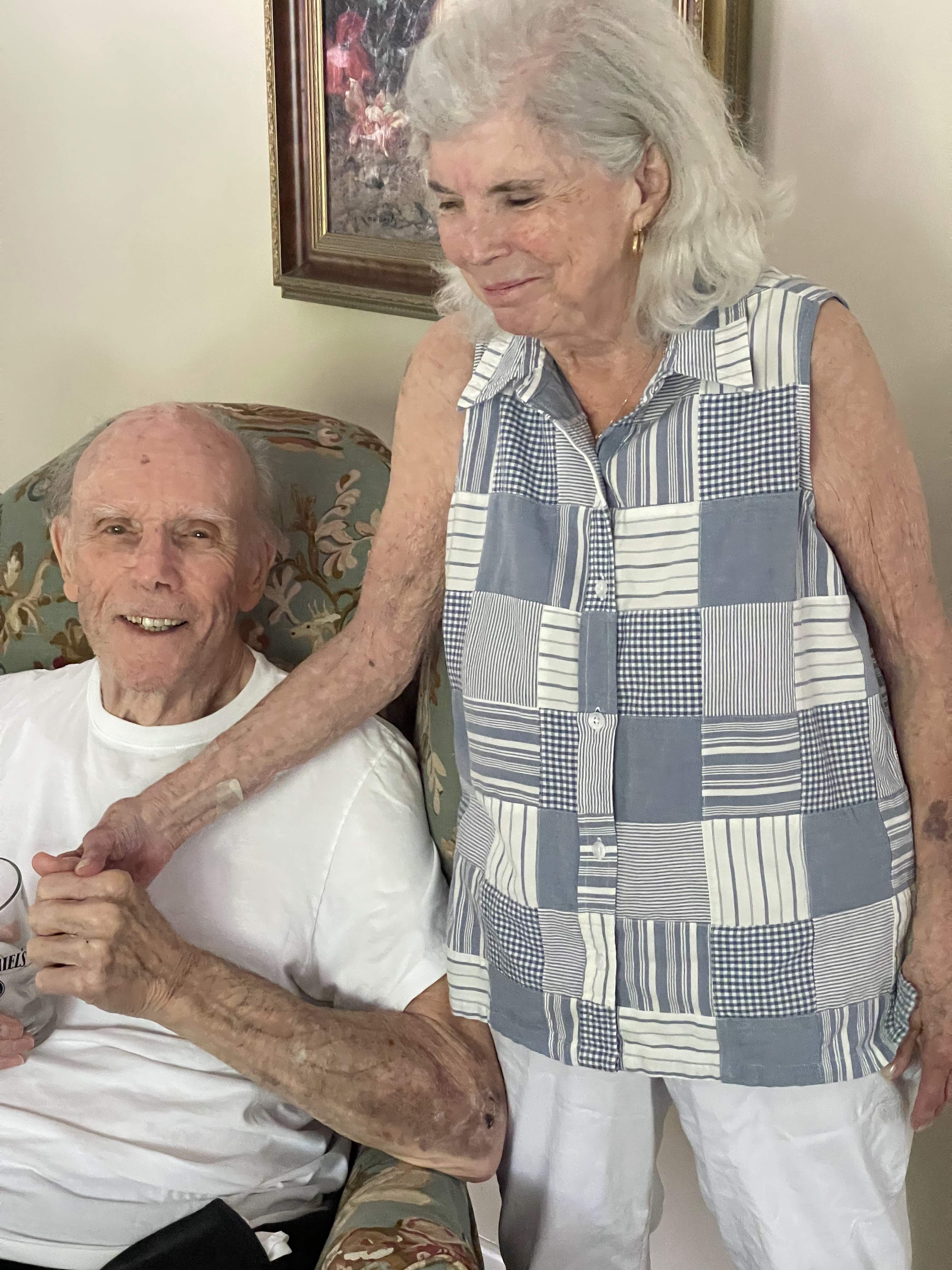
 My parents; two of my favorite people.


How to See God (This is my Sermon)

by Meta Herrick Carlson   First,  here’s my playlist   for this sermon. Enjoy! Here are the  lectionary readings for Easter 3, Year A . Also...